10 Hypnotic Art Therapy Activities For Deep Relaxation
Can’t sit still to meditate? Try these 10 hypnotic art activities to lower cortisol, stop ruminating thoughts, and achieve deep relaxation. No talent required—just rhythmic motions to quiet your mind and reduce stress.
Hypnotic art therapy is an emerging approach to anxiety relief that uses repetitive, meditative art activities to bypass the “thinking” brain and speak directly to the nervous system. Unlike traditional art classes that focus on skill or aesthetic output, hypnotic art is a form of somatic regulation. By engaging in predictable, rhythmic hand movements, you can trigger a “down-regulation” of the stress response, effectively moving your body from a state of fight-or-flight into a profound flow state.
Why Repetition Soothes the Mind
Why does drawing endless circles or shading a box feel so satisfying? It isn’t just a distraction; it’s a physiological reset mechanism. Here’s how it works:
The Rhythmic Entrainment
Did you know that your brain is hardwired to sync up with repetitive external rhythms? This phenomenon is known as entrainment. Just as your heart rate might slow down to match a steady drumbeat, your brainwaves begin to mimic the rhythmic, back-and-forth motion of a pen or brush. Research suggests that these repetitive motor tasks can stimulate the production of alpha brainwaves—the same patterns seen during deep prayer or light hypnosis.
Somatic Safety via Predictability
Anxiety thrives on uncertainty. Repetitive art offers the opposite: total predictability. When you engage in a repetitive motion (like stippling or hatching), your brain knows exactly what’s coming next. This predictability signals safety to your nervous system, allowing your body to shift from “fight or flight” (sympathetic) to “rest and digest” (parasympathetic) mode.
The Flow State
Psychologist Mihaly Csikszentmihalyi defined flow as a state where you are so immersed in an activity that time seems to disappear. Hypnotic art hits the goldilocks zone for flow: it’s complex enough to require focus (stopping you from ruminating) but simple enough to avoid frustration (stopping you from stressing).
Bypassing the Linguistic Brain
Talk therapy and journaling engage the language centers of the brain. Art bypasses language entirely. By focusing on visual rhythm and tactile sensation, you quiet down the over-analyzing part of your brain.
Before you begin
Silence can be intimidating. To enhance the hypnotic effect, pair your art activity with:
- Brown Noise: Deeper and rougher than white noise, excellent for quieting a busy mind.
- Binaural Beats: specifically in the Theta (4–8 Hz) or Alpha (8–14 Hz) range, which are associated with deep relaxation and light trance states.
Set a timer for 15-20-30 minutes, or as long as you want. This frees you from checking the clock and gives you a definite “finish line,” which makes it easier to relax.
10 Hypnotic Art Activities
By choosing “hypnotic” activities, you aren’t just doodling; you are providing your brain with a predictable, safe pattern that allows the amygdala (the brain’s fear center) to finally stand down. You aren’t just making art; you are rewiring your immediate emotional state through the power of repetition.
Textured Concentric Circles
The Concept
This activity involves freehanding nested circles and then “texturing” them with repetitive hatch marks. The circle is a universal symbol of unity and wholeness, and by building them outward from a single central point, you create a visual “anchor” for your wandering thoughts.
Why it’s Hypnotic
The exercise uses two layers of repetition. First, the large-scale motion of drawing rings, and second, the micro-motion of adding hundreds of tiny dashes. This “layering” of focus is incredibly effective for shutting down intrusive thoughts; as soon as your mind starts to wander, the shift from one color or texture to the next pulls you back into the present.
Step-by-Step Guide:
Step 1: The Freehand Foundation
Begin by freehanding several large circle shapes across your paper with a pencil. Crucially, do not use a stencil or a guide. The goal here is self-acceptance; let the circles be wonky, wobbly, or oval. These imperfections actually make the final piece look more organic and alive.
Step 2: Growing the Rings
Pick your first circle and place a single dot in the center. Using tempera paint sticks or markers, begin drawing concentric rings around that dot, working your way outward. Choose colors randomly. Removing the pressure to coordinate colors prevents your analytical brain from overthinking the aesthetic. Continue until your circles begin to overlap and fill the whole page.
Step 3: The “Hatch” Trance
Once your page is filled with color, take a fine-tip acrylic marker. Over each colored ring, begin making simple, repetitive hatch marks or dashes. Use contrasting and complementary colors (e.g., yellow marks over a teal ring) or use only black and white markers. The repetitive “tap-tap-tap” or “dash-dash-dash” of the marker creates a rhythmic auditory and tactile experience that is deeply grounding.
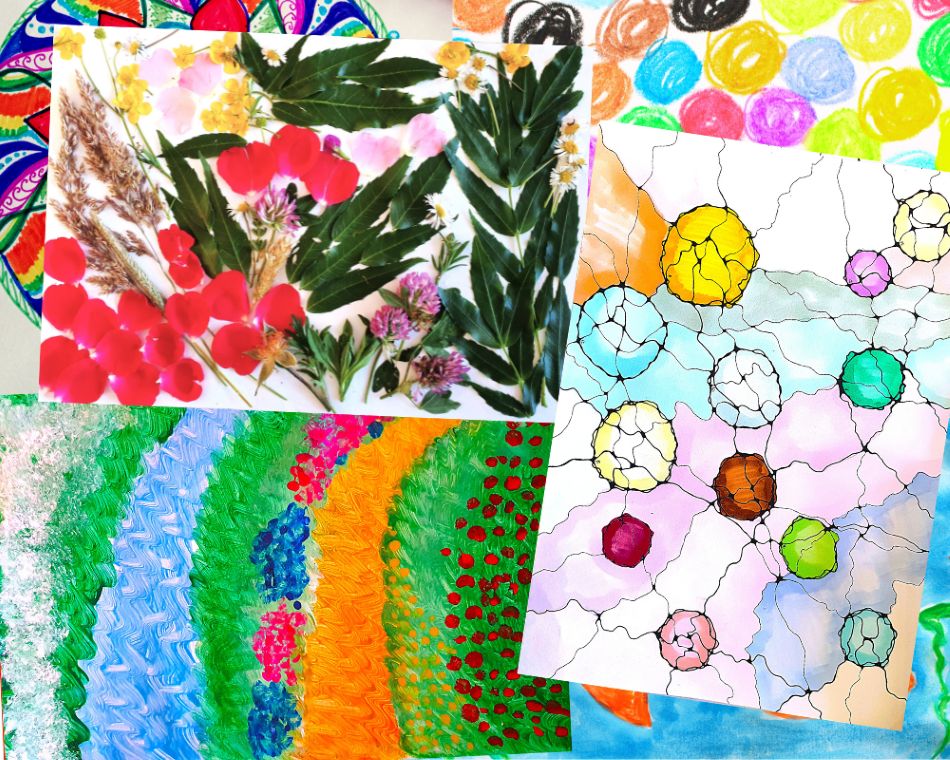
Neurographic Art
The Concept
Developed by Russian psychologist Pavel Piskarev, Neurographic art is a method of transforming chaotic, sharp lines into smooth, flowing connections. It mimics the look of neurons and biological cells. While the full therapeutic method is complex, the simplified version is a very effective tool for anxiety because it focuses on “rounding” sharp corners—literally and metaphorically smoothing out conflicts.
Why it’s Hypnotic
The human brain instinctively reacts to sharp angles with alertness (they represent danger or thorns). Soft curves represent safety. The process of hunting down every sharp intersection on your page and turning it into a curve is a tedious, repetitive task that requires just enough focus to shut out the rest of the world.
Step-by-Step Guide:
Step 1: The Cathartic Scribble
Take a thin black fineliner or a marker. Think about a problem or just the general feeling of stress you are holding. For 3–5 seconds, scribble wildly and freely across the page. Let the lines cross over each other multiple times. Do not try to make a shape; just release the energy. You can do this with your eyes open or closed.
Step 2: The Rounding
This is where the magic happens. Look closely at your scribble. Wherever two lines cross, they create a sharp “X” or “V” shape. Your job is to fill in those sharp corners with ink, turning them into soft curves. Do this for every single intersection on the page.
Step 3: Thickening and flowing
As you round the corners, you may notice some lines look thin and weak while others are thick. Go over the lines again, making them organic and wavy rather than straight and rigid. Extend some lines toward the edge of the page so the drawing feels like part of a larger network.
Step 4: Color (Optional)
If you wish, use pencils, text markers, or watercolors to fill in the “cells” you have created. Don’t worry about staying inside the lines. Just let the color flow across the boundaries if it wants to.
Radiant Sunbursts
The Concept
This exercise involves drawing simple solid circles and surrounding them with tiny, radiating lines. It’s specifically designed for “high-static” days when your brain feels cluttered. By limiting your choices to just two shapes—a circle and a line—you remove the decision fatigue that often accompanies anxiety, allowing the creative process to feel like a relief rather than a task.
Why it’s Hypnotic
The shift from the smooth, sweeping circular motion of the hand while creating circles, to the short, rhythmic movements of fingers while making dashes creates a satisfying sensory contrast that helps your brain fully descend into a Theta-wave flow state.
Step-by-Step Guide:
Step 1: Scattered Seeds
Using tempera paint sticks or markers, draw and fill in simple circles of various sizes and colors all over the page. Don’t worry about placement or “clashing” colors; let them be scattered at random.
Step 2: The Sunburst Trance
Take a fine-tip marker and begin making small dashes (rays) around the perimeter of every circle.
Step 3: Filling the Voids
If you have white space left, fill it with tiny “micro-sunbursts” using a different color, like gold or bronze marker. The density of the patterns across the page creates a sense of completion.
Rhythmic Rainbow Arcs
The Concept
In this activity, you’re drawing a simple series of rainbow-shaped arcs that cover the whole page. Sequencing is a cognitive skill that often breaks down when we are overwhelmed by stress; we lose track of steps, time, and priority. By physically building a rainbow—layer by layer, arc by arc—you are gently coaching your brain back into an organized state.
Why it’s Hypnotic
The “back-and-forth” rocking motion required to draw an arc is physically soothing to the nervous system, much like the rhythmic swinging in a hammock. This exercise is particularly effective for those who feel “tight” or physically anxious, as it encourages a larger, more fluid range of motion in the wrist and arm.
Step-by-Step Guide:
Step 1: The Primary Arc
Start at one side of the paper, using a tempera paint stick or an oil pastel, draw a large, sweeping arc. Use a color that feels “joyful” or “grounding” to you. Draw a few more smaller arcs.
Step 2: Nesting and Layering
Continue drawing arcs underneath or inside the first ones, experimenting with different colors. Do not pre-plan the palette; just pick the next color that “calls” to you.
Step 3: Intuitive Doodling
Once your rainbow is formed, use black, white, or gold markers to add dots, lines, or zig-zags within the colored bands of the rainbow. This “micro-detailing” acts as a visual reminder that the process is meant to be fun and effortless.
Rhythmic Watercolor Swooshes
The Concept
This exercise involves using watercolors and a brush to create long, repetitive curved lines that stack across the page. You follow the line that came before, and you follow the flow of the water on the paper. This creates a mental state known as soft fascination—a type of attention that is focused but not straining. It is pure relaxation with color and rhythm, designed to give your brain a total rest.
Why it’s Hypnotic
Most of our days, we deal with some kind of stress—inner chatter, “to-do” lists, and worry loops. Because this activity repeats one single long line, it allows the brain to stop spinning. The predictable nature of the curves allows your brain to stop being on “high alert” because it can easily predict the next move.
Step-by-Step Guide:
Step 1: The First Swoosh
Using a round brush and a watercolor, draw a long, fluid, curved line from the top to the bottom of your page.
Step 2: The Parallel Path
Pick a second color and draw a line that follows the exact curve of the first, staying as close as possible without touching.
Step 3: The Orderly Flow
Continue this pattern across the page, moving through the colors of the rainbow. As the page fills, the repetitive motion will naturally slow your heart rate and breathing [02:30].
Step 4: The Edge Cleanup
Use just the very tip of your brush to crisp up any jagged edges. This micro-focus keeps you engaged without causing “performance stress.”
The Dream Circle
The Concept
This activity starts with a large circle. By drawing a circle, you are creating a boundary. Inside this boundary, you translate your subconscious goals—a feeling you want to cultivate or your dream for the future—into colors and shapes. It isn’t about drawing a literal object; it’s about using color as a language to represent energy that hasn’t found words yet.
Why it’s Hypnotic
This activity induces a “visual trance” through the intersection of intention and abstraction. The brain enters a state of focused daydreaming. As your hand moves within the circular boundary, the repetitive motion acts as a physical anchor, allowing your mind to wander through your aspirations while your body stays grounded in the present moment.
Step-by-Step Guide:
Step 1: Draw the Boundary
Begin by freehanding a large circle. This is your safe space.
Step 2: Select Your Palette
Choose colors based on the temperature of the emotion you want or the dream you have.
Step 3: Fill the Void
Begin filling the circle with abstract marks—swirls, clouds, or blocks of color. Do not lift your crayon more than necessary; keep the movement fluid.
The Scribble Garden
The Concept
This activity is a powerful metaphor for neuroplasticity—the brain’s ability to change itself. It begins with high-tension, chaotic scribbles that represent stress, anger, or anxiety. By slowly coloring in the messy scribbles, you’re turning them into an organized, beautiful garden.
Why it’s Hypnotic
You start with fast, erratic movements (the scribble) and transition into slow, deliberate, and circular motions (the petals and leaves). This transition mimics the biological process of tension and relaxation. As your hand slows down to fill in the loops, your heart rate and breathing naturally follow, leading you out of a high-beta brainwave state (stress) and into an alpha state (relaxation).
Step-by-Step Guide:
Step 1: The Tension Release
Grab a black or dark colored crayon. For 10 seconds, scribble with intensity in 3 to 5 spots on the page.
Step 2: The Blooming Phase
Look at the loops in your scribble. Treat each loop as a petal. Use soft, soothing colors to carefully fill in these spaces.
Step 3: The Connection
Draw long stems from the bottom of your “scribble-flowers” to the bottom of the page.
Step 4: Details
Add small leaves along the stems or grass at the base using repetitive, rhythmic upward strokes.
Scribble & Search
The Concept
This activity is an exercise in Pareidolia—the human tendency to see meaningful images in random patterns. It is an excellent tool for those who feel stuck or trapped in rigid thinking patterns, as it forces the brain to look at the same “mess” from multiple perspectives until something new emerges.
Why it’s Hypnotic
By focusing your eyes on a complex web of lines, you engage the part of the brain involved in object recognition. This intense visual searching is a form of present-moment awareness meditation. Your internal monologue is temporarily silenced because your brain is fully occupied by the puzzle of the lines.
Step-by-Step Guide:
Step 1: The Continuous Line
Close your eyes or look away and draw one long, continuous, wandering scribble for 30 seconds across the whole page. Do not lift the pen until you are finished.
Step 2: The Rotation
Look at the scribble and try to find a shape. Turn your paper. Look at it again. Turn it again. Look at it from different angles.
Step 3: The Discovery
Once you spot a shape (a bird’s wing, a face, a heart), choose a color to trace and accentuate that shape so it stands out from the background.
Step 4: Details
Add details and shadows to found objects.
Bilateral Drawing
The Concept
Bilateral drawing involves using both hands at the same time. In art therapy, this is often used to facilitate whole-brain integration. Most of our daily tasks are dominated by one side of the brain (usually the analytical left side). By forcing both hands to move in tandem, you encourage communication between the left and right hemispheres, which can help process emotions and reduce the feeling of being mentally overwhelmed.
Why it’s Hypnotic
This is a purely somatic hypnotic technique. Because using two hands simultaneously is a complex motor task. You cannot easily worry about your taxes while trying to make your left and right hands move in perfect mirror symmetry. The brain becomes fixated on the physical task, creating a deep, meditative focus.
Step-by-Step Guide:
Step 1: Get Ready
Hold a crayon in each hand. Place them both in the center of the paper.
Step 2: Mirror Symmetry
Move both hands outward toward the edges of the paper at the same time, then back to the center. Try to make symmetrical movements, like butterfly wings.
Step 3: Experiment
Experiment with drawing circles or waves, drawing differently with each hand.
Breath Syncing
The Concept
Breath syncing is the most direct bridge between art and biology. It is the visual representation of your life force. By drawing your breath on the paper, you make the invisible visible. This activity is often used in clinical settings to help patients manage panic attacks or acute stress, as it provides a concrete visual tempo for the body to follow.
Why it’s Hypnotic
This activity utilizes biological feedback. As you draw a line that goes “up” for an inhale and “down” for an exhale, your eyes see the length of the breath. If the line is short and jagged, you see your stress. As you consciously try to draw a longer, smoother line, your body naturally lengthens the breath to match the stroke. This creates a “loop of calm” where the hand guides the breath, and the breath guides the hand.
Step-by-Step Guide:
Step 1: The Inhale Up
Place your crayon on the left side of the paper. As you take a deep breath in, draw a line slowly upward.
Step 2:The Exhale Down
As you breathe out, let the line curve back down. Aim to make the “down” stroke longer than the “up” stroke (which further triggers the relaxation response).
Step 3: Continue
Repeat this for at least 10 breaths.
The Spiral Option
Alternatively, draw a spiral. Inhale as you circle toward the outside, and exhale as you slowly draw the spiral back to the inside.
In a world that constantly demands we produce, achieve, and optimize, doing something repetitive and “pointless” is a radical act of self-care.
The next time you feel the walls closing in or your thoughts spiraling, grab a pen. Don’t worry about drawing a picture. Just draw a line. Then another. Then another. Let the rhythm take over, and let your nervous system find its way back to center.
Pick one of the techniques above and try it for just five minutes today. You might be surprised by how much quiet you can find in the motion of your own hand.
Disclaimer: This article is for informational purposes only. While therapeutic art activities are a powerful tool, they are not a substitute for professional medical advice, diagnosis, or treatment from a qualified healthcare provider or therapist. If you are dealing with deep trauma or severe mental health challenges, these activities can be a helpful support or a temporary coping mechanism, but they are not a replacement for professional therapy.