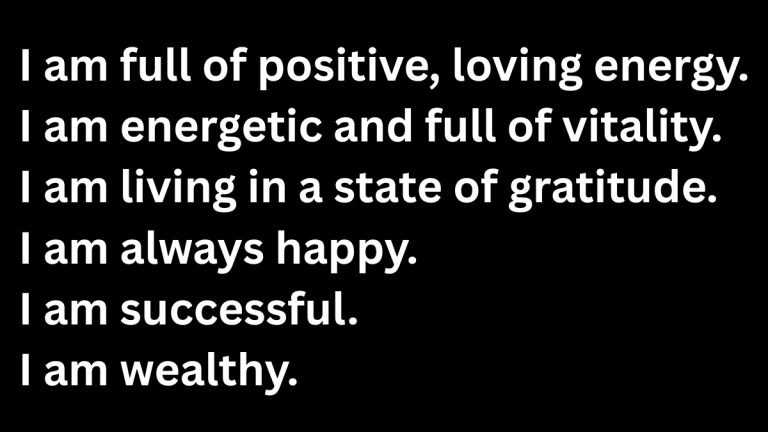
You stand in front of the bathroom mirror, take a deep breath, look yourself in the eye, and say, with as much conviction as you can muster: “I am a powerful, confident success magnet.”
You say it again. You write it down in your journal ten times. “I am a powerful, confident success magnet.”
But inside? Inside, a tiny, quiet voice is screaming: “No, you’re not! You’re late on rent, you’re afraid to ask for a raise, and you’re wearing sweatpants full of stains and holes!”
Instead of walking away feeling empowered, you walk away feeling like a fraud. You feel a heavy sinking sensation in your chest. And yet, the gurus, the life coaches, and the best-selling books all insist: “Just keep saying it until you believe it.”
Here is the uncomfortable truth that few people in the personal development industry want to admit: For many people, positive affirmations don’t just fail to work—they actually make them feel worse.
If your “high-vibe” journaling habit has left you feeling lower than when you started, you are not broken, and you are not doing it wrong. You are simply experiencing a very real psychological phenomenon known as the “backfire effect.” It’s time to put down the pen, stop gaslighting yourself, and look at the science of why your brain is rejecting your affirmations—and how to finally fix it.
The Science: Why Your Brain Rejects “I Am” Affirmations
Before we fix the habit, we have to understand the mechanism that is breaking it. The agitation you feel when you write a statement that feels untrue isn’t just a lack of faith; it is a defense mechanism.
The Latitude of Acceptance
Psychologists refer to a concept called the latitude of acceptance. This is the range of ideas and statements that a person finds believable or plausible.
When you introduce a thought that falls within this latitude (“I am capable of learning new things”), your brain accepts it and integrates it. However, when you introduce a thought that falls widely outside of this latitude ( telling yourself “I am wealthy” when you have $5 in the bank), your mind flags it as a lie.
The Backfire Effect (The Wood Study)
In a pivotal 2009 study published in Psychological Science, researchers Joanne Wood, John Lee, and Elaine Perunovic tested the effectiveness of positive self-statements. They found something startling:
“Repeating positive self-statements may benefit certain people, such as individuals with high self-esteem, but backfire for the very people who need them the most.”
When participants with low self-esteem repeated the phrase “I am a lovable person,” they didn’t feel more loved. They felt worse. Why? because the statement triggered a “counter-argument” in their brains. Every time they said “I am lovable,” their brain automatically pulled up a list of reasons why they weren’t.
The affirmation didn’t plant a seed of confidence; it shone a spotlight on the deficit. By journaling these absolutes, you are inadvertently engaging in a debate with your inner critic—and your inner critic usually has more “evidence” (memories of failures, embarrassments) than your affirmation does.
5 Affirmation Traps That Are Sabotaging Your Happiness
If you are stuck in this cycle, you are likely falling into one (or all) of these five traps.
1. The Trap of the “Present Tense Absolute”
We are often taught that affirmations must be in the present tense to “trick” the subconscious. “I am thin. I am rich. I am happy.”
The Agitation:
When you write “I am financially abundant” while looking at an overdue electric bill, you create cognitive dissonance. This is the mental discomfort experienced by a person who holds two or more contradictory beliefs, ideas, or values. The tension between Reality (the bill) and Affirmation (“I am rich”) creates stress, not relief. Your brain hates this dissonance and will try to resolve it by rejecting the affirmation as noise.
The Solution:
Switch to bridging statements. You need to build a bridge from where you are to where you want to go. Your brain can’t jump the canyon, but it can walk the bridge.
- Instead of saying: “I am a confident public speaker.” (Brain: “No, you sweat when you talk to strangers.”)
- Try: “I am learning how to become more comfortable speaking in front of others.” or “I am practicing to grow my confidence over time.”
- Why it works: These statements are undeniably true. Your brain cannot argue with “I am learning.” It lowers the defenses and allows the thought to enter.
2. The Trap of “Toxic Positivity”
Your journal is likely filled with statements that demand you feel good all the time. Statements like: “I am always happy. I radiate joy.”
The Agitation:
This denies the full spectrum of your humanity. When you force positivity, you shame your negative emotions. Then, when you feel sad, you feel like you are failing at life. This leads to meta-emotion mismatch: feeling bad about feeling bad. You aren’t just sad; now you are ashamed of being sad because your journal says you should be “radiating joy.”
The Solution:
Practice “both/and” statements. Validate your struggle while affirming your resilience.
- Instead of saying: “I am completely relaxed and zen.”
- Try: “I am feeling BOTH anxious right now, AND I have the tools to handle this anxiety.”
- Why it works: It creates psychological safety. You are telling yourself that you can handle the difficulty, not that the difficulty doesn’t exist.
3. The Trap of Outcome vs. Process
Most affirmations focus on the final trophy. “I am a CEO.” “I am a marathon runner.” “I am married to my soulmate.”
The Agitation:
Focusing solely on the outcome highlights the distance between you and that goal. It’s called the gap effect. Staring at the peak of the mountain from the valley floor can be inspiring for a moment, but if you stare too long without moving, it becomes intimidating. You feel small. The goal feels impossible.
The Solution:
Shift to value-based or process-based affirmations. Affirm the qualities required to get the outcome, rather than the outcome itself.
- Instead of saying: “I am a best-selling author.”
- Try: “I am committed to writing 500 words a day because I value creativity and commitment.”
- Why it works: This gives you a win you can achieve today. You can’t control being a bestseller today, but you can control being committed. When you write this, you feel capable rather than wishful.
4. The Trap of Declarative vs. Interrogative
This is a subtle linguistic trap. Most affirmations are declarative statements (“I am…”).
The Agitation:
Declarative statements feel like orders. If you have a rebellious mind or deep-seated self-doubt, your psyche will rebel against being told what to think, even by you. Research suggests that for some, asking questions is far more powerful than making statements.
The Solution:
Use interrogative self-talk. Turn your affirmation into a question that prompts your brain to search for answers.
- Instead of saying: “I am powerful.”
- Try: “In what ways can I show up powerfully today?” or “Why am I capable of handling this meeting?”
- Why it works: The brain is a problem-solving machine. When you ask a question, it automatically looks for evidence to answer it. “Why am I capable?” prompts your memory to find times you were capable. You are encouraging your brain into finding its own positive proof.
5. The Trap of Ignoring the Body (Somatic Dissonance)
You write the affirmation, but your stomach is in knots. You clench your jaw. You hold your breath.
The Agitation:
Your body keeps the score. If your mind is saying, “I am safe,” but your nervous system is in fight or flight, the affirmation is useless. If you ignore the somatic (bodily) reaction, you are training yourself to disconnect from your own intuition.
The Solution:
Use somatic check-ins. Before you write an affirmation, check your body. If you feel tight, adjust the affirmation until your body relaxes.
- Test: Say “I am beautiful.” (Stomach tightens?)
- Adjust: Say, “I am accepting my body more each day.” (Shoulders drop?)
- Why it works: You are aligning your conscious mind with your nervous system. When your body believes the words, the words stick.
How to Rewrite Your Journal for Real Self-Esteem
It is time to audit your journal. Open it to your most recent entry. Look at the sentences that made you cringe or feel hollow. Let’s run them through the believability filter.
Here is a quick reference guide to transforming toxic affirmations into empowering truths.
The Toxic Affirmation |
Why It Fails |
The Empowering Revision |
| “I am a millionaire.” | Factually untrue; highlights lack. | “I am capable of making smart financial choices today that build my future wealth.” |
| “I love my perfect body.” | Too absolute; feels like a lie if you have insecurities. | “I am open to treating my body with kindness and respect, even when I feel insecure.” |
| “I am fearless.” | Impossible; fear is an essential human emotion, important for survival. | “I can feel fear and still take action anyway.” |
| “Everyone likes me.” | Uncontrollable outcome; anxiety-inducing. | “I like myself, and I am comfortable with not being for everyone.” |
| “I am the best at my job.” | Comparative; invites imposter syndrome. | “I am bringing my unique skills and dedication to my work today.” |
The Neutrality Stepping Stone
If even the empowering revisions feel too fluffy for you right now, that is okay. If your self-esteem is currently very low, Neutrality is your best friend.
Neutral thoughts are the safe harbor between self-hatred and self-love. You don’t have to jump from “I hate myself” to “I am a goddess.” You just have to get to “I am a human being.”
- Neutral Affirmation: “I have a body. It functions.”
- Neutral Affirmation: “I am experiencing a thought that I am not good enough. It is just a thought.”
These boring, factual statements stop the spiral. They ground you in reality without demand. From this neutral place, you can slowly start to build up to positivity—but on a foundation of truth, not wishful thinking.
Conclusion: Honesty is the Highest Vibration
The goal of a journaling practice isn’t to brainwash yourself into a delusion. It is to support yourself through the reality of your life.
True self-esteem doesn’t come from chanting exaggerated sentences until you numb out your doubts. It comes from making agreements with yourself and keeping them. It comes from speaking to yourself with the same honest, compassionate nuance you would offer a friend.
So, throw out the script. Stop trying to “manifest a new personality.” Start writing sentences that feel true in your bones. They might not sound as flashy as the ones on Instagram, but they have one distinct advantage: Your brain will actually believe them.